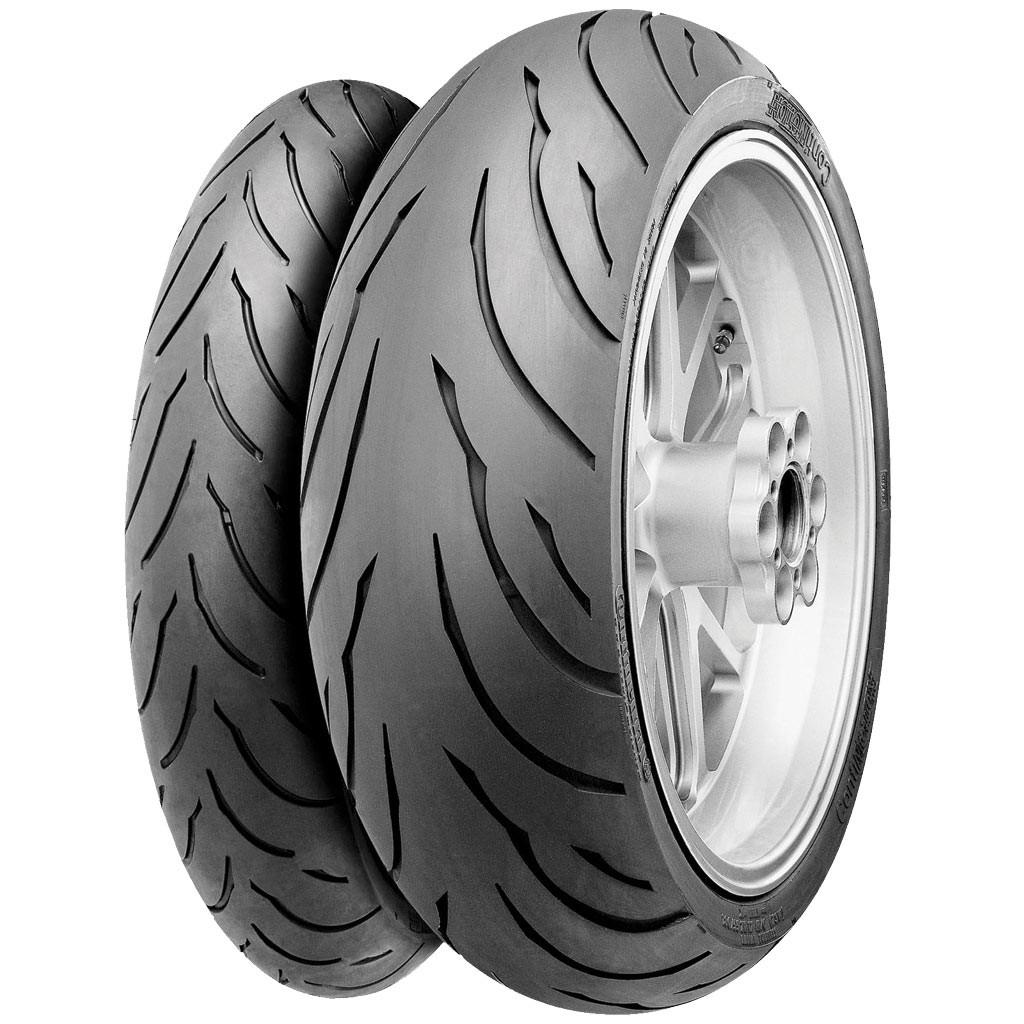
Low budget, high performance? Really?
A couple of winters ago I picked up a very capable hack (Yamaha Thunderace) on the cheap – the idea as always being to ride it until the warm weather kicked in, and then sell on, making enough to cover the cost of the riding done in between. Plus a few bucks. The Ace was excellent, but what really surprised me was the handling. Despite being a relatively heavy machine, with so so suspenders and a Brit winter to play in, the nearly new rear tyre was rapidly bedded in right to the edge. I hadn’t heard of Contimotions before encountering them on the Ace, and they seemed to me to have coped with the demanding context in which they found themselves at least as well as I would have expected from more heralded brands.
Forum inquiries yielded sparse but positive praise for the budget radials, budget being very much the operative word.
Fast forward to the supposed summer of 2016, and another winter hack: this time unsold, unwanted, plugging on but in need of new rubber at hack price. I remembered the Contis, and did some research, which yielded a couple of points of interest. It transpired that since their low key 2010 launch no European journalist had bothered to review these widely used tyres – presumably because they’re at the less sexy end of the spectrum, barely considered as the Sports Touring material they really are. The Contis boast only a light scattering of online enthusiasts as supporters: no one else gets a hard on for this rubber, apparently. Not even the manufacturer, Continental, who ushered them quietly into a disinterested world, referencing them from day one as a ‘budget choice, entry level tyre’. Which may be damning with faint praise, but containins a significant truth: I could buy them now, six years on in Brexit Blighty, for £130 a pair…. Or, alternatively, I could write them up and ask the UK distributor to send me a pair in return for the labour. Clearly stunned that anyone should bother asking, Cambrian Tyres – official UK Continental importer – sent me a pair at once.
As we all know, less can sometimes be a whole lot more. And so it turned out. Let me tell you about Contimotions: they’re pretty much as good as you’ll want them to be, wet or dry. Forget about beginners or commuters and just ride. Confidence, as someone once pointed out, is a preference. Tick that box and almost any modern tyre works, and works well: but not every modern tyre can be described as genuinely budget. I’ve had the Contis out in all weathers, one and two up, and performed a full on emergency stop without the option (and without ABS). No problems.
The one thing I haven’t been able to do on them is a track day – there just hasn’t been time. But I know of a track day regular who did his best ever ZX9 lap time at his local circuit (Oulton) on Contimotions. He’s not the only one to have found them willing accomplices at the track. So how do we square the disjunction between price and performance, reality and reputation?
I asked Bryn Phillips (the go to guy for tech talk at Cambrian) for an answer to this apparent conundrum. Contimotions feature a single compound, zero degree steel belt construction for stability at speed, with a diagonal variable depth tread pattern extending into the shoulder. Tyre profile is partly determined by the ratio of height to width, but as we all know that still leaves plenty of room for variation in steepness of shoulder. The Contis are just on the conservative side of steep, with a rounded rather than precipitous shoulder. However, profile alone does not account for a bike’s willingness to turn in – Bryn pointed out that the stiffness or rigidity of the carcass plays a significant part. The Contis are slightly on the soft side, responding in a linear fashion to steering input. They don’t suddenly tip in or generally sharpen up the ride, they simply do the job that is being asked of them, in proportion to your input. The single compound means that while there isn’t an overwhelming sense of grip, what is available is constant and seamless. A possible negative is longevity, or lack of it: tyre life might be limited compared with some competitors – the Contis don’t have a reputation for being particularly hard wearing, especially on heavier, torque hungry machines – but there is little evidence to suggest that they are very much inferior to the sector competition.
All of which places them bang in the middle of the spectrum, and explains why they so predictable and versatile: they represent a kind of perfect median – Bryn reckoned that this was the well kept secret of their success. Conti were aiming squarely to fill a spot at the bottom end of the market with a no frills product and quality construction. It worked, even though the Contis remain almost totally ignored by the media. These tyres may be six years old in terms of design, but the formula remains a winning one.
I’ve had these tires on the track attached to a R1200GS and never had a problem. They warned up and got sticky and stuck to the track, not even a little slip on hard acceleration out of the corners. I think Contimotion tires are a excellent all around tire.
Bought a 2004 BMW R1150RT-P last year with these tires already installed; don’t know the mileage on them but I’ve put more than 2k and really have no complaints – they stick well and have no problems in terms of unwanted twitches / wanderings…have noticed that the back tire lifts and shifts/reseats itself on the road when I go over a patch of gravel on the tarmac (central Virginia backroads) – a bit un-nerving at first but I suspect its the work of the tread design…
Had two sets on my ER6 pumped to 32psi front 36psi rear. Got 8,000km 5,000m out of them. Got 12,000km 7,500m out of a pair of Michelin Pilot Road 2. Michelin were about $100 more expensive than Continental radials. Continentals wore and rode well, gave good grip and handled predicably.
Only reservation I have is that tyre fitting and balancing costs me $100 a pair. So long-term running Continental instead of Michelin levels out as the extra cost of the Michelin is offset by the less frequent fitting cost.
So, I would fit 2 pairs of Michelin over 24,000km vs 3 pairs of Continental.
2 pairs of Michelin cost an extra $200. I save $300 on 3 pairs Continental
but I spend $300 fitting three pairs versus $200 fitting 2 pairs of Michelin.
Much is made of the 2CT on Michelin Pilot Road 2, and I found they did wear less in the centre to flat spot less, but I found they still scalloped. In NZ we have chip seal roads that are coarse and cambered. When you have to ride kerbside cornering and keeping out of the way of windblast from trucks you wear the shoulders more on 2CT tyres than on single compound tyres.
In short, I find Continental work as well as Michelin for me. If I knew I was going to take a long tour, then I’d get Michelin fitted to last 50% longer.
But for usual weekend riding I’m fine fitting Continental. Good radial tyre.
Continental radial tyres are better riding and handling than any bias tyres.