Here’s the most definitive account yet of what actually happened. Massive thanks to the people who helped.
1./ FOLLOW THE MONEY
Very little that has been revealed regarding the recent collapse of Norton Motorcycles into administration is actually new. This website covered many of the same issues in 2012 and 2013, by which time the key players in the saga had already made their entrance. Since then, a lot of people in the motorcycle industry have either known or suspected that something was seriously amiss at Norton – but public dissemination of their concerns was evidently not a priority.
The Bauer Media sector of the bike press, for example, whose titles dominate the UK market, consistently claimed that they were ensnared in a classic double bind. If they reported what was apparent, they supposedly risked flushing the entire operation down the plug hole, putting people out of work and leaving depositors stranded – at a time when UK manufacturing output remained lingering in the doldrums.
Unfortunately, many of the things the press claim they were trying to protect were either massively overstated or entirely spurious. Registrations and output never matched the levels CEO Stuart Garner talked about, but the media were not the only ones effortlessly duped. Having generously agreed that the taxpayer should underwrite a £625k loan from Santander, the government produced a further 2.3m for the administration of an apprentice scheme, which specified the construction of a specialist academy HQ. It never materialised in that form: the building which should have housed the apprentices was given over to storage for the CEO’s collection of Aston Martins. Spondon Engineering (acquired by Garner in 2010) existed in name only: the plant was sold off; the real estate sold to make way for a housing development, and the paper company that was left was used as the basis for R&D tax relief claims (along with the non existent Academy), cited by Garner himself (in the recent HMRC case, 8/1/20) to be in the region of £300,000.
A suspicion therefore remains that a considerable percentage of the staff were actually in place to facilitate rebates by being deemed R&D workers: ironically, sources inside the factory have confirmed that insufficient R&D plagued the entire operation. The chart below is essentially an artwork, and an incomplete one at that. Nevertheless, it may repay further scrutiny: click to enlarge.
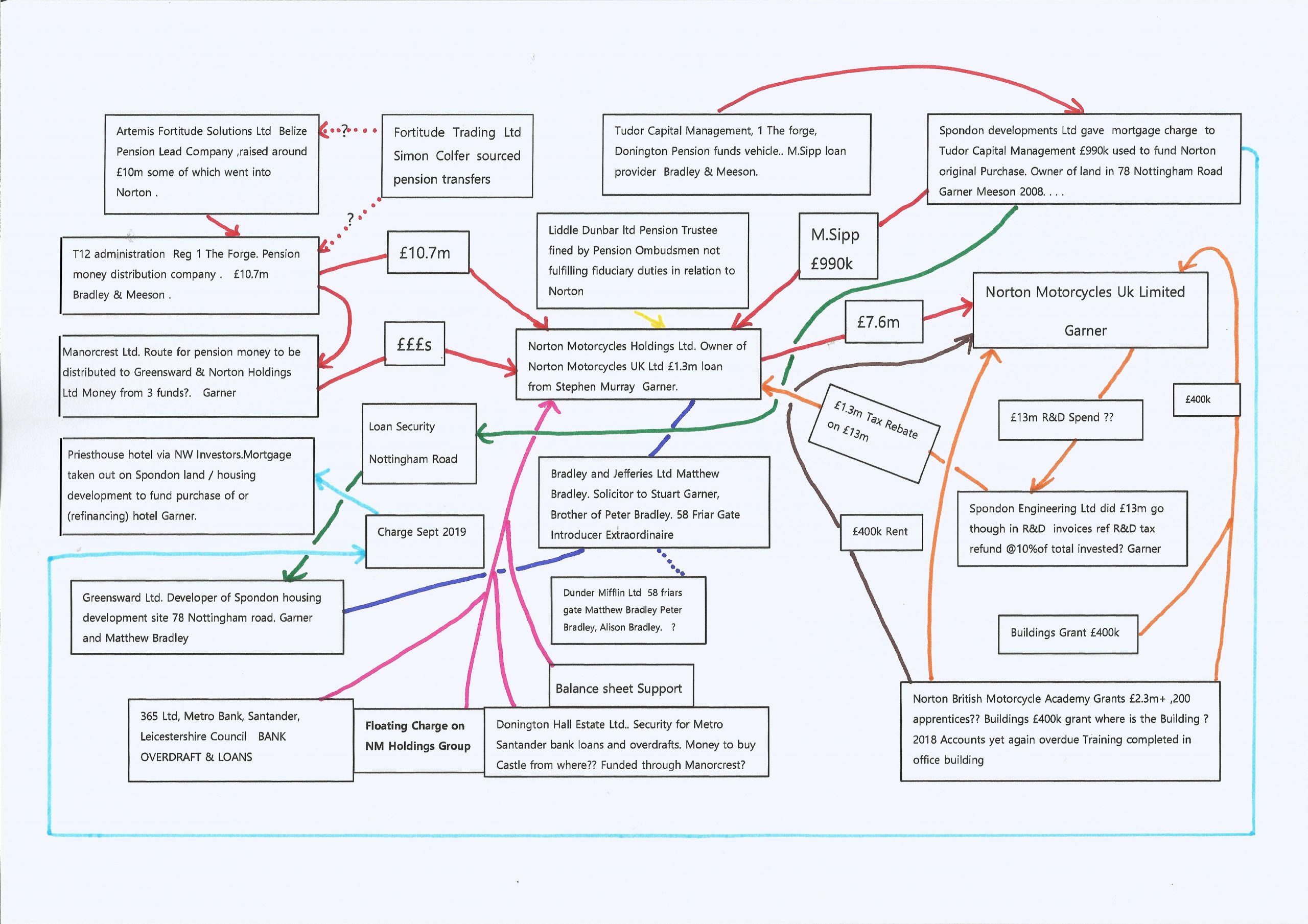
A lot of money – £10.7m – was diverted from illegally sourced pension funds which subsequently ended up as Norton shares. Having already been sanctioned three times by the Ombudsman in scathing reports, Garner is facing a further inquiry into claims made by a group of aggrieved fund holders concerning the handling of their pensions. On top of this, questions are being asked about a £1m loan to Garner by Tudor Capital Management, a company funded on the proceeds of tax fraud, for which two individuals (Andrew Meeson and Peter Bradley) with other connections to Garner were convicted in 2013. Those connections included a company called T12 Administration (Meeson and Bradley, directors) which registered pension funds with HMRC. Monies from harvested pension lines were processed via T12 from a variety of sources, including Simon Colfer, subsequently convicted in 2018 for pension fraud. The liberated pensions then found their way into Garner run companies. Since Garner was also the trustee of the pension funds, the matter of a conflict of interest arises which appears to directly contravene Section 39 of the 1995 Pensions Act. Moreover, the final transfers into shares (2012/13) took place after Meeson and Bradley were convicted for the tax fraud and sentenced. As Garner was himself a witness at their trial, he must have been aware that he was processing funds from a company with two of its three directors in prison. I asked Garner specifically about the original Tudor loan in a published interview in 2013, but there was little appetite elsewhere for following the story up.
2./ CHAOS THEORY
And so to the bikes. The original 2012 Bikerglory investigation revealed a catalogue of complaints from dissatisfied customers and suppliers. Comments from aggrieved individuals continued to accrue, and by last year it was clear that the same old problems had once again reached a critical point. A senior sales manager at Norton in post after 2012 has made a statement to Bikerglory which reveals the chaotic circumstances he found himself working in.
Right from the beginning, he was dogged by deposit holders running out of patience in the quest to have their motorcycles delivered. Suddenly money became available, and the manager refunded close on £1m to aggrieved complainants, which provides some idea of the scale of the problem. There were constant ongoing issues with suppliers and machinery: plant was removed from the premises as payment for it had been withheld. The manager had serious reservations about the lack of both R&D and quality control, and questioned role of Simon Skinner, Garner’s chief designer and factotum: other employees have shared his scepticism.
More seriously, he says that bikes which left the factory contravened their homologation documents, a serious consequence of the broken supply chain. This is corroborated by other sources, some of whom also witnessed the removal of parts from customers warranty bikes in for repair – which were subsequently fitted to ‘new’ machines in an effort to get them out of the door. An aggrieved owner, John Hamilton, has taken to Twitter with footage of the recovery of his stripped machine from the factory. The administrators, BDO, contacted at least one other customer with the news that his bike had also been stripped. Recent documents given to this website suggest that other owners with a similar story have laid their information before the police.
3./ THE BONFIRE OF THE VANITIES
It didn’t have to be this way. There would have been no shame in Garner having machines built in their entirety by Norton licence holder Zongshen in China, and subsequently assembled and badged at the Donington HQ. There would have been no spares problems, no order problems, a smaller wage bill and reliable bikes for customers. He’d have had a workable operation. Instead, he sold off the intellectual property and trade rights in different territories (the Indian firm Kinetic picked up the available Asian rights last year), but by then time was running out, and Donington remained home to the 961 and doomed V4 projects (with warranty claims rapidly coming home to roost). Garner was desperate to retain maximum control until it was too late – by which time Norton was regarded by the industry worldwide with some suspicion: the brand was becoming toxic. Now that the administrators have moved in, there will be contenders seeking to cut themselves a rights deal, but anyone who ends up owning any part of Norton would be well advised to lie low with their new acquisition for a while yet.
In 2012 the problem was a basic lack of liquidity, but since then some serious money has flowed into Norton and its associated companies. To no avail: it appears the CEO’s ambitions had parted company with sustainable business practice. Perhaps Stuart Garner feared that if he delegated production entirely to outside sources, his image would somehow be undermined. And it was an image which required some serious maintenance: the country seat at Donington Hall, the Aston Martins, the game park in South Africa. The blingy V4RR, with its highly reflective chrome surfaces, and the SG1 designated race bike seemed to allude to the prioritisation of image above all else. It’s impossible to imagine a Triumph race machine rolling out of Hinckley with JB1 moniker attached to it.
The marque opened doors for Garner in politics, show business and in the pit lane, but it was all a massive facade – one which people who should have known better were unable or unwilling to see through. Garner has undoubted charm and intelligence, and was almost genius level at selling his narrative: the readiness with which individuals and organisations alike abandoned diligence while throwing money at him bears testament to that. There is less excuse for the journalists and media commentators who continued to promote Norton while being well aware of the issues surrounding the operation. They were at best naive, at worst complicit. These people enabled the meltdown, yet there still seems to be a lot of denial at work. Almost no one, irrespective of their role in the saga, emerges from it with their credibility intact: eyes remained wide shut.
Since Norton went into administration, some commentators have theorised that the whole raison d’être behind its purchase was essentially fraudulent. For what it’s worth, I’m not convinced that this was the case. While it’s inescapable that after the Meeson trial at the absolute latest, the CEO must have known that both loan and pension money alike had a highly questionable provenance, that does not mean that the company was picked up as – for example – a laundering opportunity. It’s far more likely that Garner never intended to keep Norton in the first place. It would have made a lot of sense to flip the deal for a quick buck by rapidly passing it on to the highest bidder; the value was all in the brand, rather than the boxes of questionable parts which came with it. Several people have told me that this was in fact exactly what Garner tried to do – but that his preferred buyer, John Bloor, wasn’t keen: and thus the die was cast. I think Garner ended up holding a baby he’d never intended to keep, and had little idea how to handle.
It’s hard to think of a business less suited to ad hoc decision making than the manufacture of road legal motor vehicles – it just can’t be done on the fly. Given what we know of what was actually going on, it’s remarkable that the ball was kept in play for so long. Stuart Garner at Norton appeared to be constantly fighting fires of his own creation; ultimately they consumed him. Many others got burned along the way.
I really need to thank Nick for bringing the Norton debacle to my attention via his original article (The Norton Saga) in 2012. Thanks to this heads-up and the subsequent involvement of the Pension Ombudsman, I managed to get my entire £100k pension fund returned in 2016, amazingly together with all the interest as promised in the original offer and for good measure the ombudsman found Garner at fault and fined him too.
I appreciate this is of no comfort to current ‘investors’ within the three Norton funds, still unsure as to the whereabouts of their monies. My heart goes out to them.
how much did he make on the Chinese deal
As of this week Stuart Garner is still saying the ill informed press and rumors are wrong. He messaged me the same. Deluded.
I read your Norton story in 2012 and 2013, and was stunned at how long this has been going on for. Huge red flags were waving when they announced IoM TT racing, V4 models, the Atlas, and the plethora of special edition 961s – when it was common knowledge that established customer orders were not being delivered (and perhaps not even being built), and existing bikes were experiencing ongoing quality issues.
Perhaps the Norton case begs a broader question over the integrity of the automotive industry as a whole. Garner Norton is one of many canaries in the coalmine over many decades: Liz Carmichael, John Delorean, Philip Sanghi,Carlos Ghosn, to name a few preceding infamous examples. Who is there to protect the consumer, when authoritative systems (i.e. government) are not? This is where ethical journalistic practice is critical in protecting consumer rights. The Bauer Media argument of “double bind” is a propositional fallacy that masks the reality of experience. If Norton was a well managed company and the accusations baseless, then it would weather any negative publicity through conducting ongoing good business.
‘Perhaps the Norton case begs a broader question over the integrity of the automotive industry as a whole.’ It does, but I reckon that VW’s dieselgate scandal made a pretty decent stab of it. The VW thing was exposed by environmental protection agencies and academics in the USA, not the auto press. It’s a sobering thought if the only people capable of investigating multi nationals are government organisations…
From Derbyshire Life and Countryside January 2015
“At that time, Stuart’s father, mother and all of his teachers must have wondered whether the lad would amount to much. Raised in Barrow on Trent and educated at Chellaston, the 16-year-old Stuart left school with no qualifications.
As Stuart remembers: ‘My parents were disgusted because they’d done all right for themselves and my elder brother was at university. I think mum and dad had given up on me; I was the black sheep of the family. School gave me no focus; academia left me cold. I preferred bird-nesting and playing snooker and, as soon as I got a motorcycle, I was scrambling down at the gravel pits. I didn’t want to be in the classroom – I just wanted to do “boy’s stuff”.’
Doing boy’s stuff also blemished Stuart’s first job opportunity: after three years as a gamekeeper at Foremarke Hall, he was sacked – ‘the hours were very long and exacting and I was too much into girls, motorcycles and beer’ – but the boy started to grow when he dated a particular girl. ‘I was 18 and my girlfriend’s dad was a bit Victorian. He said, “You’re not taking my daughter out if you haven’t got a job. You can start in my warehouse on Monday”.’ ”
https://www.derbyshirelife.co.uk/out-about/events/at-home-in-donington-hall-with-stuart-garner-of-norton-motorcycles-uk-ltd-1-3918557
From Derbyshire Life and Countryside January 2015
“As a glittering exemplar of the entrepreneurial spirit, Stuart’s take on his success with Norton is refreshingly simple: ‘Making a motorcycle business earn money didn’t seem to be a very complex problem and I think the simplicity of my approach made it successful. My design team know that making a great motorbike is complicated but when I had a meeting with those guys, my approach was “just press the ‘make’ button, boys.” I gave them the problem of making the bikes and, by not getting bogged down by the detail, I was able to concentrate on the rest of the business – dealing with finances, brand value, market position, distribution and dealer network – in order to sell at a higher price than it cost to make, and make a profit. Business is simple, really: buy the product at £1, sell it for £2 and make sure you operate for less than £1.’”
https://www.derbyshirelife.co.uk/out-about/events/at-home-in-donington-hall-with-stuart-garner-of-norton-motorcycles-uk-ltd-1-3918557
I am genuinely and honestly surprised this stuff took so long to blow up.
In 2012 I became intrigued with the new Norton Commando and went to check it out at the local importer. They had a bike bike I was told it would not possible to test-ride it because it was a “non-runner” for static display alone. Apparently it was missing several engine parts. Given what we know now it was a shape of things to come. But they did have a big pile of slick brochures.
As in the past I already had my fair share of troubles with small motorcycle manufacturers I asked the importer a long list of questions. I started out simple: how long for delivery and how big a deposit? He told me he had no idea about delivery time and he needed to “ring the Donington HQ” to hear about the deposit. Next up I asked to see the workshop manual. I was told they had not received it yet. Fine, let’s talk with the head mechanic. He hasn’t been called up for training yet. OK, then what happens if I need a brake lever or a mirror? We have no idea how long it would take to arrive. At this point I just thanked this useful idiot and went home.
I wrote about my experience in a letter to the magazines (completely ignored) and in several forums (laughed at by Norton fanboys). Two weeks later I bought a Honda CB1300SF I still own: no need to ring the HQ to put a deposit on one of those.
Generously, or perhaps naively, I simply told people Norton was a fly-by-night outfit, the typical small manufacturer with huge dreams but very little in the way of substance.
However over the following years I saw Norton become a media darling while deliverying such a small number of bikes they are an incredibly rare sight, perhaps even rarer than the fabled Honda NR750. But on the forums the “little stuff” was piling up: incredibly long delivery times, difficulties getting warranty jobs done, impossible to obtain spare parts (and not for the original Commando)… but, hey, Norton was developing a V4 racebike! The media reactions were very telling, as are the embarrassed attempts to limit damages right now.
Mercifully there are still folks around who have no problem telling the truth and who are not easily swayed by smoke and mirrors.